
Mystery of the Missing Calories: Why Your Nutrition Label Math Doesn’t Add Up
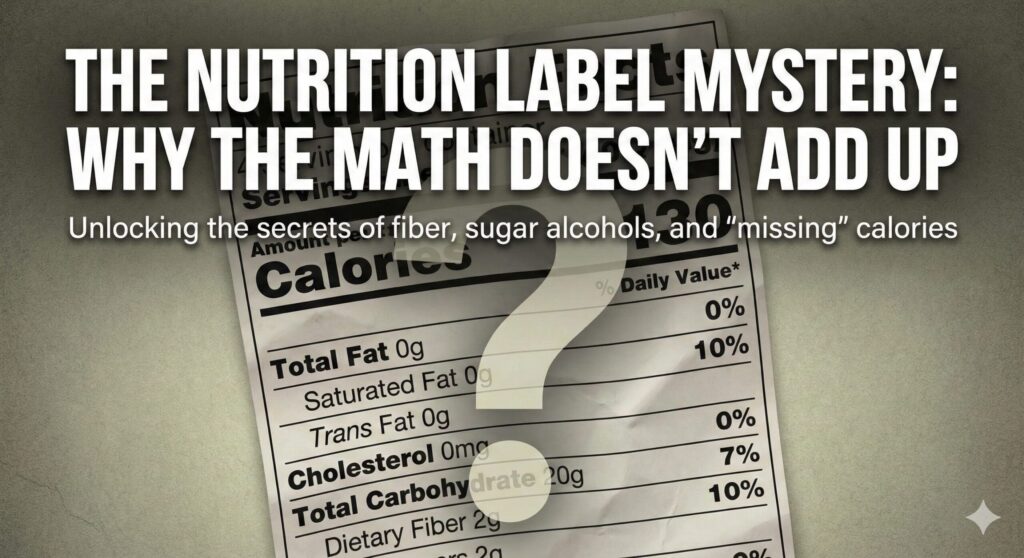
Have you ever experienced nutrition label gaslighting?
Why the classic “4x protein + 4x carbs, + 9x fats” doesn’t always equal the calories on the library and why it usually happens in the health food aisle.
Grab a protein bar or a “keto-friendly” snack, diligent about your nutrition, you glance at the macros on the back. Do the quick mental math (4x protein + 4x carbs, + 9x fats) only to find that the total calorie count listed on the wrapper is significantly lower than what you just calculated.
Is this company lying? Can I not do basic multiplication? What is going on?
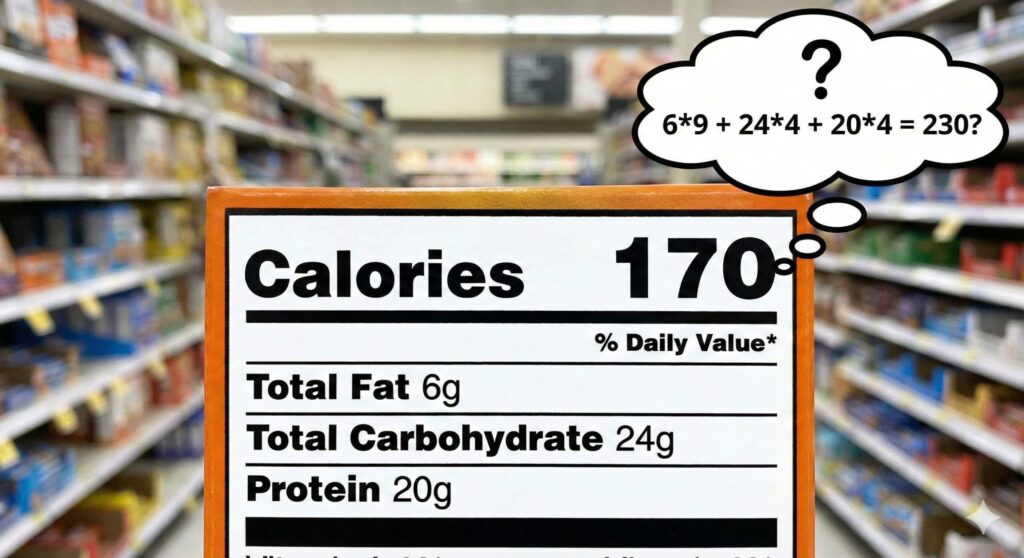
Recently, a member shared a perfect example of this non-intuitive experience: A protein bar listed 6g Fat, 24g Carbs, and 20g Protein.
Using standard nutritional math, that bar should have roughly 230 calories. But the label proudly declared: 170 Calories. The member asked the MackCrows Track Coach to check again after they saw the difference. You may also occasionally you ever noticed a warning symbol (“Yellow Triangle” ⚠️) next to an item in your log, this means the item you logged is notably outside the bounds of that calorie estimate calculation.
Where did those 60 calories go? They didn’t vanish into thin air. The answer lies in the confusing, often misunderstood world of how the FDA allows companies to calculate carbohydrates.
Here is a breakdown of why nutrition labels often defy basic math.
The Traditional Math (The 4-4-9 Rule)
For decades, the gold standard for estimating calories has been the Atwater System, often simplified as the “4-4-9 rule.” It’s what most of us use to track our intake:
- Protein: 4 calories per gram
- Carbohydrates: 4 calories per gram
- Fat: 9 calories per gram
If you apply this rule to our mystery protein bar, here is what you get:
- Fat (6g x 9) = 54
- Carbs (24g x 4) = 96
- Protein (20g x 4) = 80
- Total = 230 Calories
If the math is so simple, how can the label claim 170?
The Loophole: Not All Carbs Are Created Equal
The 4-4-9 rule assumes that your body perfectly digests and absorbs every single gram of carbohydrate it consumes.
But biology is messier than math.
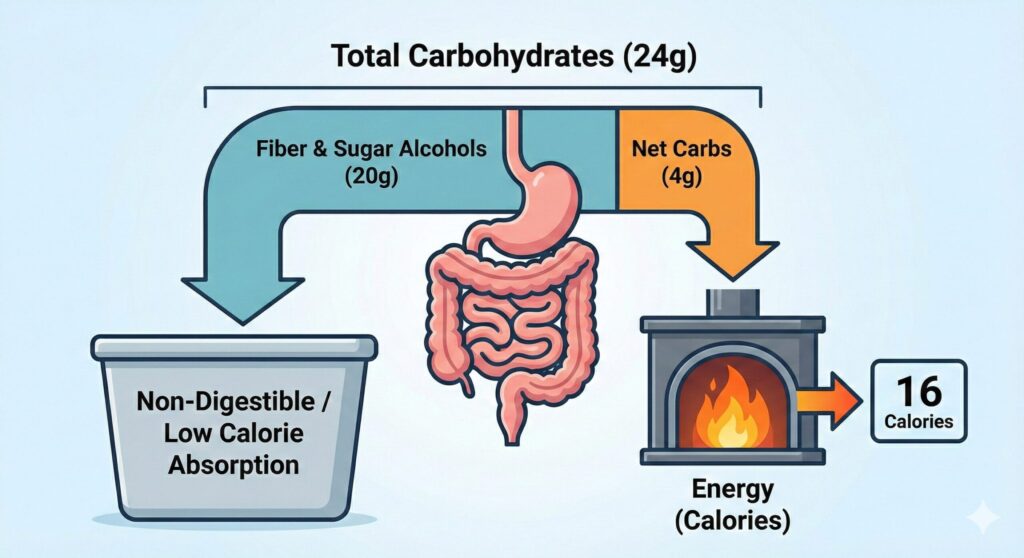
The FDA recognizes that the human body cannot fully break down certain types of carbohydrates to use for energy. If your body can’t digest it, it can’t be converted into a calorie that “sticks.”
The two main culprits responsible for “missing math calories” in this case are Fiber and Sugar Alcohols.
1. The Fiber Factor
We are told to eat fiber because it keeps us full and aids digestion. But humans lack the enzymes necessary to break down many types of fiber.
Because it passes through the body largely intact, the FDA allows manufacturers to discount the calorie count of fiber. Instead of the standard 4 calories per gram, insoluble fiber can be calculated at essentially 0 calories, while soluble fiber is often calculated around 2 calories per gram.
2. The Sugar Alcohol Stealth
If you are eating a low-sugar or “keto” product that tastes sweet, it’s likely loaded with sugar alcohols (look for ingredients ending in “-ol,” like Erythritol, Maltitol, Xylitol, or Sorbitol).
These sweeteners act like carbohydrates, but their chemical structure makes them difficult for the body to absorb.
- Erythritol, for example, is often calculated at 0.2 calories per gram (virtually zero) because almost none of it is metabolized.
- Others, like Maltitol, are absorbed more and count for roughly 2 to 3 calories per gram.
Solving the Mystery Bar
Let’s look back at the example bar. The math said 230 calories, but the label said 170. That’s a 60-calorie difference.
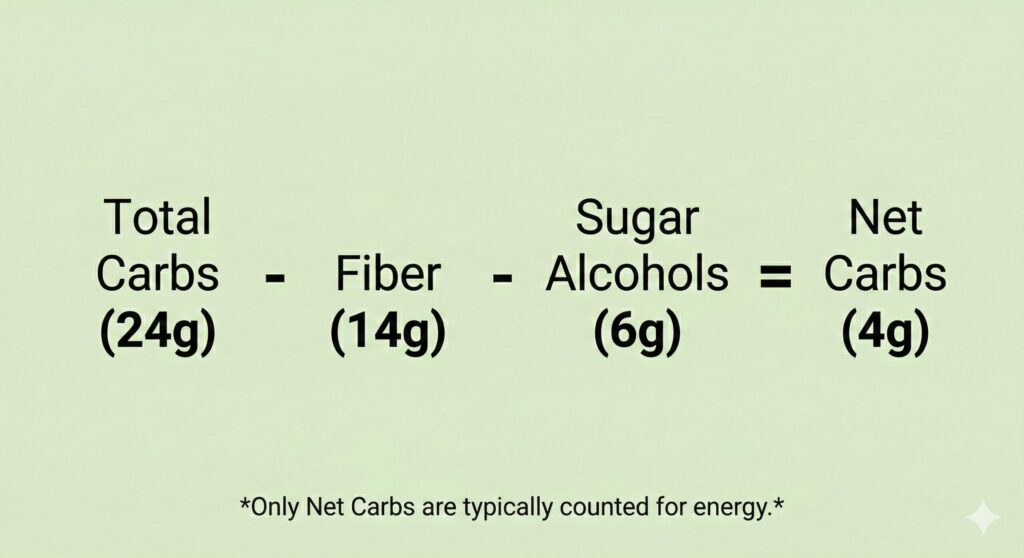
When we looked closer at the ingredients, the answer was obvious. The 24g of total carbohydrates included:
- 14g of Fiber
- 6g of Sugar Alcohol
This means out of 24 grams of carbs, only 4 grams were “standard,” fully digestible carbohydrates (like sugar or starch).
The manufacturer used FDA guidelines to subtract the non-digestible parts of the fiber and sugar alcohols. They aren’t saying those ingredients don’t exist; they are saying your body won’t be able to extract energy (calories) from them.
This concept is often marketed as “Net Carbs”—calculating only the carbohydrates that significantly impact blood sugar.
The Takeaway: Trust, but Understand
It is an incredibly frustrating user experience to look at a label and feel like the numbers are lying to you.
The good news is that they aren’t lying. In fact, the lower calorie number listed on the package is usually a more accurate representation of the energy your body will actually absorb from that food than raw 4-4-9 math.
When you see a high-protein, low-sugar product where the math doesn’t add up, check the fiber and sugar alcohol count. You’ll almost certainly find the missing calories hiding there in plain sight.
-
Why do calories not add up to the macros?
Is this company lying? Can I not do basic multiplication? What is going on? Recently,…

Leave a Reply